Archive for Michigan Press Association

State of the State: That Sinking Feeling

State of the State: That Sinking Feeling

One of the big downsides to January in Michigan is the annual State of the State address. (Of course, the main upside to January in Michigan is that it isn’t February.) We have not been blessed with governors who are accomplished orators, at least not during the time that I’ve been editorial cartooning.

John Engler was so bad it was actually part of his charm. (That may be the only published instance where you will see “charm” and “John Engler” in the same sentence.) He was an effective behind-the-scenes guy who was clearly uncomfortable speechifying. You could almost see the thought balloon above his head as he talked, “My hands. What do I do with my hands?”

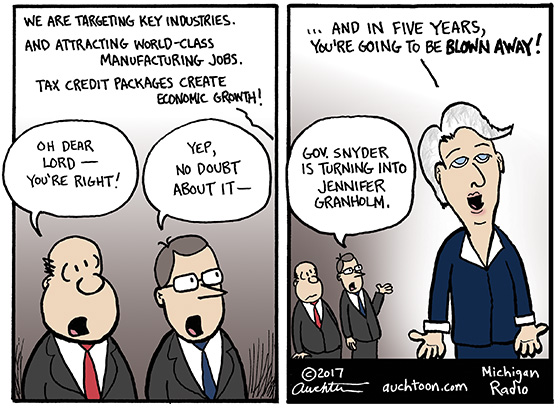
Jennifer Granholm had skills but in the “smart kid hitting all her marks” sense. Technically there, but something much less than inspiring. True, as governor during Michigan’s lost decade, she had some pretty grim material to work with. But then so did Churchill, and he did okay. (Perhaps governors should be required to deliver all future speeches using a British accent.)

Before I dump on Governor Snyder, I should mention my own deficiencies in this area. When I was in high school I purposely took debate and forensics in an effort to become decent at public speaking. Thank goodness this was before ubiquitous recording devices and YouTube because I was bad. Legendarily bad. There were times when I could see in a judge’s eyes her longing for a tranquilizer gun to put me down and end everybody’s misery.

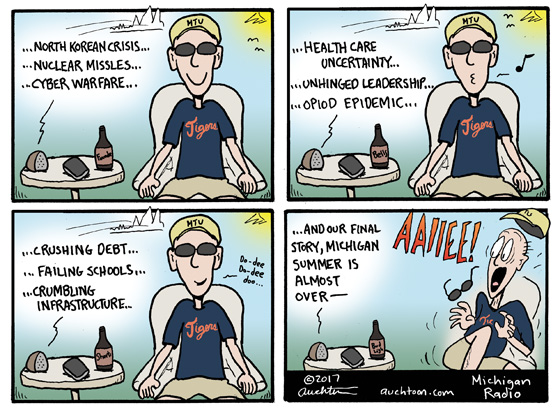
The remarkable thing about Snyder’s address wasn’t the expected not-so-great delivery, it was the content. Both Engler and Granholm pretty much gave up in their last terms, but here Rick Snyder seemed to be announcing “I’m kinda done with this” ahead of time!

Especially the infrastructure thing. I know it’s a tough gig with a Republican legislature actively working against him. (Admittedly, drawing him disappearing into a sinkhole probably isn’t helping, either.) But I think this would have been a good time to rally Michigan citizens with some sort of definitive plan! Oy.

I guess what I’m saying is, out of the two farewell addresses I heard in the last week, I preferred Obama’s.

Comments

The Biggest North American International Auto Show Story

The Biggest North American International Auto Show Story

The Amazon TV-series “The Man in the High Castle” explores an America in which the Allies lost World War II and Nazi Germany and Imperial Japan rule over our country. A 2004 mockumentary, “C.S.A.: The Confederate States of America,” considers what might have happened if the South had won our Civil War. These sorts of alternate histories can be highly entertaining and also add perspective to real history through drama and satire.

I’d love to see a take on modern America, and specifically Michigan, if the automobile industry had been allowed to collapse eight years ago. I think it would be fascinating, especially if it used real economic models to extrapolate the consequences.

Of course, the reality was that the auto industry contracted hard, but first the Bush Administration and then the Obama Administration provided cover for survival. And credit where credit is due: It was Michigan autoworkers, from designers in Ann Arbor, to engineers in Detroit, to line workers in Flint (as well as suppliers and fabricators all over state) who contributed mightily to bring it back to its very healthy current state.

That good health is fairly obvious at the North American International Auto Show (NAIAS) presently going on in Detroit, and radically different from the NAIAS of 2009. Today we are talking about viable, mass-produced fully electric cars (the Chevy Bolt), a top-level pickup truck (Honda Ridgeline) not built by the big three, and — my goodness — the rebirth of the minivan (Chrysler Pacifica). We even have a major player (Volkswagen) openly confessing its sins and accepting the punishment. That’s progress!

In fact, one of the few similarities between now and then, is the chatter of government intervention. Back then, it was substantial and serious and critical to survival. Today it is randomly generated tweets. If you think about it, that too is progress, and I’m glad not to be in a Michigan of alternate history.

Comments

« Previous Page « Previous Page Next entries »